
Confronting Mortality and the Dynamic Inner World: A Dialogue with Mwinji Siame

CONFRONTING MORTALITY AND THE DYNAMIC INNER WORLD
A DIALOGUE WITH MWINJI SIAME
Mwinji is a freelance writer and artist based in Lusaka, Zambia. She has works of varying genres in places like Feminist Food Journal, The Bosphorus Review of Books and The Republic. When she is not writing, she enjoys being outside in nature, picking her acoustic guitar and spending time with her loved ones.

BY NKATEKO MASINGA
This conversation took place between Zambia and South Africa, via email.
Nkateko: Hello, Mwinji. Thank you so much for agreeing to have this conversation with me. Congratulations once again on being shortlisted for the Ubwali Hope Prize. Your shortlisted story, Hometown Glory, reeled me in right at the start. As a confessional writer, I have a penchant for the “I” voice of first-person narration, but after reading your story, consider me a new convert to the gospel of the third person. Perhaps it is the strength of the dialogue in your piece, or the vividness of your descriptions, or a myriad components of good storytelling together, but it works so well that I felt as if I was reading about people I know and that Ivwa was fighting a cause I care about (which is true). Was that your intention, to give your readers the illusion of a safe distance, only for them to realise they have been right next to Ivwa all along, feeling everything she feels? That’s how it was for me. I think the word is engrossed. I was engrossed in Ivwa’s world, and for several reasons which we will get to, I felt I could relate to her experiences, beyond what was said. I was filling in the blanks for myself.
Mwinji: Thank you so much for our kind and insightful words, to start. I am glad to hear I wrote a character or story that is relatable. I hope my characters come across as human, so that’s affirming of that — that another real life human finds them relatable.
Secondly, I’m beaming that I have been able to convert someone to close third, like the little crusader I am. And originally this story was very omniscient third. But then after a conversation with the editor for this story and the founder of Ubwali, Mubanga Kalimamukwento, I was like, maybe second person is it. So it was sort of natural, but I think there was a bit of intention behind it.
I want to get up close and personal. I want to suck the reader in, and I think importantly, let a woman suck up most of the narrative air in the narrative room. Main character syndrome but without the way “I” can sometimes devolve into solipsism.
Furthermore, I think the other value of close third as well is that sense of safety you mention. When you are dealing with this very dynamic inner world that is also a little chaotic and traumatic, I think you want that safe distance, for you and your reader. So it was maybe an act of self-care and care for the reader. I do think about my reader — even when I write text messages haha — too much in the past, but definitely it’s still there even with the most banal conversations.
But yes, grief, heartbreak, a little bit of sexism — those are intense subjects that need a bit of distance. But I also think we shouldn’t avoid them. The hard parts offer the most wisdom.
Nkateko: I am a huge advocate for leaning into the hard parts instead of shying away from them. But I realise as I get older that I am becoming selective about the pain that I am willing to lean into. I am reminded of a poem titled The House, by Warsan Shire. The first stanza reads as follows:
Mother says there are locked rooms inside all women.
Kitchen of lust, bedroom of grief, bathroom of apathy.
Sometimes, the men— they come with keys,
and sometimes, the men— they come with hammers.
There are experiences that I avoid talking about because I fear that if I open those doors, I won’t know how to close them again, or I won’t have the strength to keep them closed because my trauma will be spilling out of those doorways and making a mess everywhere.
Mwinji: I definitely get you on that one. Yet at the same time I would say as a writer and as a person I’ve learnt to open those doors gently. I think gentle love is one of the ways those doors open.
There are people that come with hammers and people that come with-as cliché as it is-casserole dishes, fresh produce and flowers. It’s those people-friends, family and all the different kinds of relationships I am blessed enough to enjoy with people I am blessed to know, that have made me feel safe enough to face up to the past, to even embrace it in a way, to embrace everything about me. You know, just knowing I have a gentle place to land, so to speak.
Poetry, and literature, words when assembled well and true, art that comes from a true place, are also my gentle, safe place. And that doesn’t mean that safe isn’t difficult or that there’s no uncomfortable conversations or things that bristle or are prickly, but just that you kind of know where it’s going.
Nkateko: I hear you. Soft landings imply that there is a fall to consider, an impact to mitigate, and in the context of interpersonal relationships we need to remember that nobody comes from nowhere. We all have a past, with traumas and triggers that we carry with us as we make our way through this adventure called life. It is a gift to be held with care when the internal storm is raging and a fall is imminent. I have been fortunate in that aspect too.
I am curious about poetry being one of your gentle, safe places. Is there a particular poet whose work resonates with you in a way that makes you feel seen?
Mwinji: Emily Dickinson. There’s something invigorating about her poetry even when she’s writing about death. And I can relate to that obsession or confrontation with mortality that she explores. That as well as the sense of seeing the profoundness and life force in everything-her communion with nature and with poetry and literature itself. The soul. Ifi Amadiume, generations ahead and a continent away. There’s a sense of completion and self-assuredness I admire and that also makes me feel self-assured or that I can be, that I can find my footing if I’ve lost my way. Vanessa Angélica Villarreal is very real in her poetry. I know you said one, but there’s more than one. And the danger with me is I like to have my cake and eat it, sometimes.
“When you are dealing with this very dynamic inner world that is also a little chaotic and traumatic, I think you want that safe distance, for you and your reader.”
Nkateko: Oh, I would never begrudge you that. Poetry is the one thing in the world I shamelessly overdose on. But tell me, how does a lover of poetry end up as a writer of fiction and nonfiction?
Mwinji: Yeah, so I do love poetry and I do write it, but I don’t share it in public, often. Maybe also, I don’t want another genre I have to really learn. I have quite a few creative and expressive hobbies — guitar, dance, drawing, painting. I’m now comfortable with the fact that I’ll probably always be an amateur at those — except visual arts, which I’m determined to really become fairly good at now — and I do them for fun.
So I think I want to be able to have an expressive medium where I can be cringe and do it really badly. It’s kind of like a way of decompressing from the pressure of fiction and this very serious non-fiction I write about culture and all these big intellectual discourses. And all my other work where I have to do them within parameters — a word count, a thematic concern, a formula for how it should be structured or a specific end goal. Like, I wouldn’t go to a poetry workshop as a very serious thing — maybe just for exposure.
That said, one of the first little vignettes I had published-I think I was about twenty or twenty-one -was called It All Became Like Poetry. It was published in Munyori Literary Journal. At that age I think I was expressive in the way a poet was. But as I’ve grown older, and maybe leaned into my pragmatism, I just want to say exactly what I feel and mean without the weight of formal conventions or thinking about this or that literary device.
But I do admire poets. I know one or two really beautiful poets. They are poets. I have some poetry in me, but I’m not a literal poet-maybe in the sense of crafting something and having a certain perspective on how to live life, but I don’t do poetry like that. I think Jonathan is a poet though in his past life, he’s attentive in some ways. Obviously, I wrote that in because I find that attractive. A man with a sense of poetry — even if he’s not a creative — not sort of just guns blazing about everything, and quite attentive.
Nkateko: You’ve unlocked memories of a discourse I used to engage in quite frequently about a decade ago in the South African open mic spaces: What makes a real poet? What is and isn’t poetry? There would be murmurs about prose poetry being too simplistic and Instagram poets not showing reverence to the craft, and it was during that time that I bought myself a copy of The Poet’s Companion by Kim Addonizio and Dorianne Laux and decided to learn the rules of all known poetic forms, even new ones such as the burning haibun, invented by torrin a. greathouse, which essentially whittles a prose poem down to a haiku by writing an erasure of the initial prose poem, and then erasing that poem into a haiku.
In this process of learning, I discovered that I can write a mean ghazal, and my pantoums are nothing to sneeze at, but there is nothing that I love more than combining forms to create new ones as Greathouse did with the burning haibun, and what Jericho Brown did with the duplex – a hybrid of a ghazal, sonnet and blues poem. That is what led me to teaching online poetry workshops – the possibility of contributing to the creation of new forms. I believe that poetry is a lot like cooking. It is a gift, yes. A calling too, some might say. But it can be taught and learned, if you don’t mind opening a recipe book. I actually found “It All Became Like Poetry” while looking for more of your work online and the opening paragraph had me convinced it was a prose poem because of the imagery. It took further reading for me to realise that it was a short story but I still think it has the heart of a poem.
I don’t know if I fully agree with your analysis regarding Jonathan. I think that Ivwa is poetic, and her light was reflecting on him so at times it appeared as if he was glowing too.
Mwinji: I loved poetry. It’s still there in my writing though, maybe, actually. In tiny glimmers. I think my first literary “award” was a bronze English Olympiad certificate for a poem I wrote in High School. I think it was about dictatorship and corruption…which is wild for a fifteen-sixteen year old, but I suppose literature, even the more age-appropriate literature I read at the time, did make me aware that we had this colonial legacy but also this failure by the people who now had power. I couldn’t express that in intellectual, theoretical ways, but I observed what it meant for lived realities and I suppose poetry then entered. I wrote quite a few poems and short stories like that when I was a teen. It’s weird because now I avoid getting too intense and didactic about things like that. Or maybe I just do it more subtly through class, relationship dynamics etc.
I like that you’ve said Ivwa shone her light. I had a thought the other day whether some of the praise I give to the people in my life is me actually projecting some of my own good qualities, or that I also have those things in me even if they also do and that’s why I notice them in others. I’ve rebuilt my self-image over the last couple of years, but it’s something that will occasionally come up where I just assume the other person has these amazing qualities because maybe also they’re more socially acceptable even if they aren’t even that kind or compassionate or attentive a person. But I’m really proud that I’ve come far with that. Writing has helped me. Exploring these different parts of myself.
And maybe yeah, Jonathan was actually a so-and-so. I’ve written another story which I’m hopefully going to get to workshop where there is actually a “good guy” that’s good for the main character. There are excellent examples of wonderful men all around me. Men who make me feel safe, are in touch with their emotions, do right by their partners, view women as people even while observing tradition and culture, but there is a way that men are also socialized into behaving the way Jonathan does.
Then of course men like Jonathan are aided and abetted in their behavior. Not just by men but a bit by women like Ivwa’s mother who’s maybe of the generation that are like “men are just naturally non-monogamous” and “as long as he comes back home to you.” In Zambia, I think we’d probably call that the shipikisha generation. That said, there’s a bit of nuance. I wanted to explore that too because maybe some of these highfaluting women actually have maybe always had this implicit agreement with their husbands. I mean, Ivwa’s mum hints that she might not be so innocent. But of course it’s how we go about these things and everyone consenting that this is what I am okay with. Jonathan definitely pretends it is one thing when it is another.
Nkateko: I think we would have been friends in high school. What I now call my “angry Black woman phase” began in my teens and intensified in my early 20s (Now I am a tired Black woman). I have always been very sensitive to injustice, and you are absolutely right that poetry thrives where intellectualism and theory fail because I did debating (the adjudicator was a very handsome senior student whose smile contributed 60% toward my motivation for joining the club), public speaking (this is where I developed my love for the stage) and poetry (I wrote poems for The Glaive, the school magazine) and poetry is the one I stuck with until now because it is where I can express my emotions, raw and unfiltered. For poems commissioned in corporate, I refer to my public speaking playbook, reining in my emotions and channeling them towards the subject at hand.
I am the type of person who models the behaviour I want to see in a relationship, hoping that this will inspire reciprocity. It usually doesn’t (laughs) and I have realised how that affected my perception of my self-worth. It became a conversation of “Am I undeserving of the consideration I have shown to you?” What helped me with that was realising that my behaviour was quite manipulative and the idea that people have different ways of receiving and giving love. So someone who enjoys receiving gifts might not reciprocate with gifts but might show up and clean my entire house and cook me a meal when I’m too depressed to get out of bed.
Do you believe that people are inherently good or bad? Is a man who is a terrible partner but a good father still a good man?
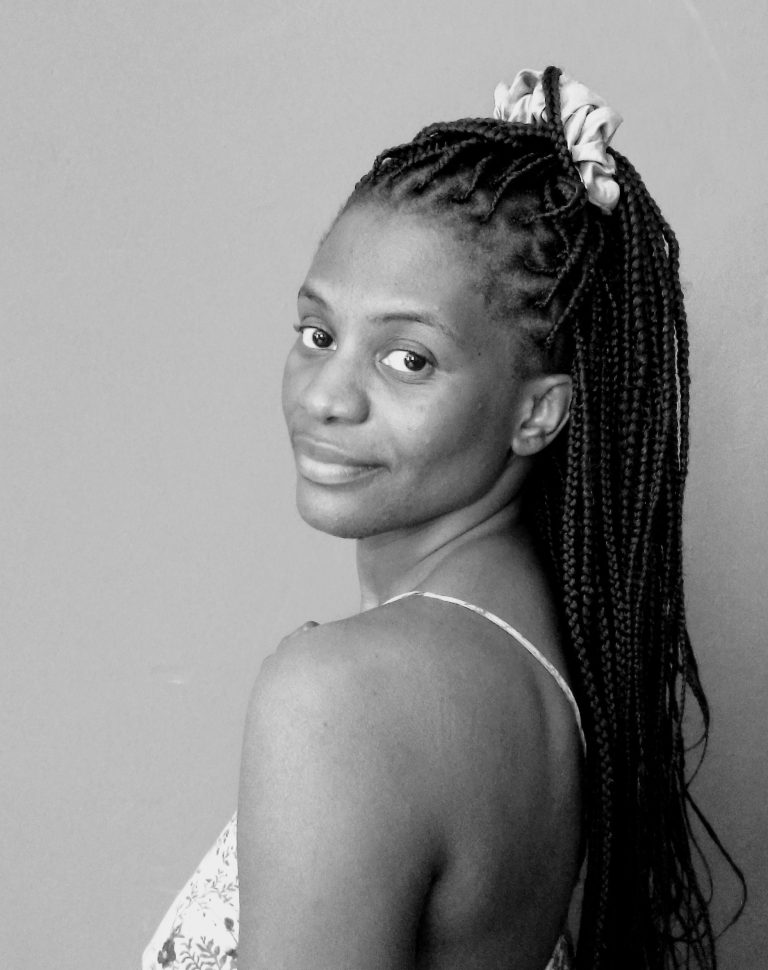
Mwinji: Haha, maybe, maybe we would have been friends. Maybe. I agree with you, you can’t force people to go beyond their limits in terms of how they show love. As for whether I think people are inherently good or bad. I think people either try or they don’t try. That’s how I like to think of it. And I think most people try to be a decent person.
Nkateko: I agree that most people try to be decent. Do you think that there is a possibility for a redemption arc for Jonathan in another story within the universe in which Hometown Glory exists? Or will Ivwa meet a good guy who is actually good for her? Your earlier response regarding women being complicit makes me think of a common practice in South African traditional wedding ceremonies, where the women elders will advise the bride to never sleep with tights on, and to never fetch a man who has gone to his affair partner’s house. This type of advice is exactly why so many women are reluctant to report the emotional and physical abuse that they are being subjected to in their relationships.
Mwinji: Yeah. So culture plays a huge role in shaping women’s experiences, men too but women in this case. In Zambia though historically, I would say we had some actually quite sensible cultural practices. We’ve had women in positions of power for centuries now. Both men and women have been instructed on how to be in a marriage in some lineages or tribes as it were.
My mother was telling me how in her part of the country where she’s from men had to go and work in the woman’s family field just to make sure he wasn’t a dud in terms of providing. Women also had to do certain things before they married. There was an expectation of mutual care to some degree-equality. I know the Bemba-speaking people, actually had or have something like a vow of equality written in their marital processes. So there was an idea of partnership and women being somewhat equal….long before feminism actually and certainly different from feminism in that it was very much about complementary existence between men and women rather than individualism or confrontation as can be the case with this very corporatized, western feminism.
Then colonialism came, and these practices were made taboo, or misinterpreted. The roles of men and women were redefined really for the purpose of organizing labor towards capitalism, rather than towards communal flourishing. They were also monetized. So now you sometimes have people who don’t know what they’re doing partaking in these things. Then you also have people with axes to grind with none of the oversight that was maybe there to make sure nobody gets abused in these processes. So I don’t think it’s always been the case that women were expected to suffer like that. When I look at how straightforward customary divorces in the Zambian context seem to be, it does suggest that suffering wasn’t something that was taken lightly and there was an understanding that things happen.
As for Jonathan-well. I think there could be a redemption arc for him. I think I’d need to get to know him more to really understand whether he’d end up with Ivwa as a good choice for her. But also whether she’d choose him even if, say he did work on himself, because I suspect she has the world at her feet as far as suitors go so there’s no need to put up with craziness. She’s not perfect of course, and I’d say there are ways she needed to grow at the start of the story and maybe still needs to, but there’s a lot going for her.
Nkateko: So many beautiful, rich and sacred cultural practices have been diluted into a form that our fore-elders would surely frown on. What I do think we have preserved beautifully as Africans is music. What is your favourite genre of music? Are there any traditional Zambian songs that you can play on your guitar? I have recently fallen in love with the genre of Xigaza (Xitsonga traditional music and dance) and although I cannot dance to save my life, when I listen to these songs I am transported back to a time when my paternal grandmother was alive and I would dance just to make her smile.
Thank you so much for having this conversation with me, Mwinji. I have enjoyed delving into the world of your shortlisted story, “Hometown Glory” as well as the many important themes it addresses. I also enjoyed our segue into poetry, and I hope that the world gets to read more of your poems soon. I wish you the very best with the outcome of the Ubwali Hope Prize, and I look forward to reading more of your work in future.
Mwinji: Hah. I actually really like Kalindula music — which was allegedly originally a mourning music from Congo — and all the ways it’s been remixed to some degree. Not strictly traditional but definitely of the soil. I can’t play any specific songs, but I have been trying to figure out the basic finger styles and so on. I can’t really dance either haha. But I also don’t really care. I’ll move my body.
I love Jazz and Blues music as well. Pop. Some country. So no favorite genres. I could be listening to PK Chishala or the Witch today, then tomorrow Jack Harlow or Travis Scott or Cent, then Amel Larrieux the other day and then Vivaldi in the shower on Monday morning. Like when I’m working or drawing or doing anything creative maybe I’m listening to Coltrane or maybe I’m listening to Skepta or Lana Del Rey or Tems or Miriam Makeba or all of them haha. Just depends. I’m not religious about music.
Thank you so much for a wonderful experience! It’s been a pleasure, and I am truly humbled by the interest in my work. Thank you so so much!

Nkateko Masinga is an award-winning South African writer whose poetry has been translated into French, Bengali, Tamil, Kannada and Romanian. Her latest book, Daughter Wound, was published by UK publisher Hazel Press in April 2024 and was named Book of the Week at the London Review Bookshop in the first week of its release.


