In Pursuit of the Magical Middle: A Dialogue with Mustafa Marwan
In Pursuit of the Magical Middle
A DIALOGUE WITH MUSTAFA MARWAN
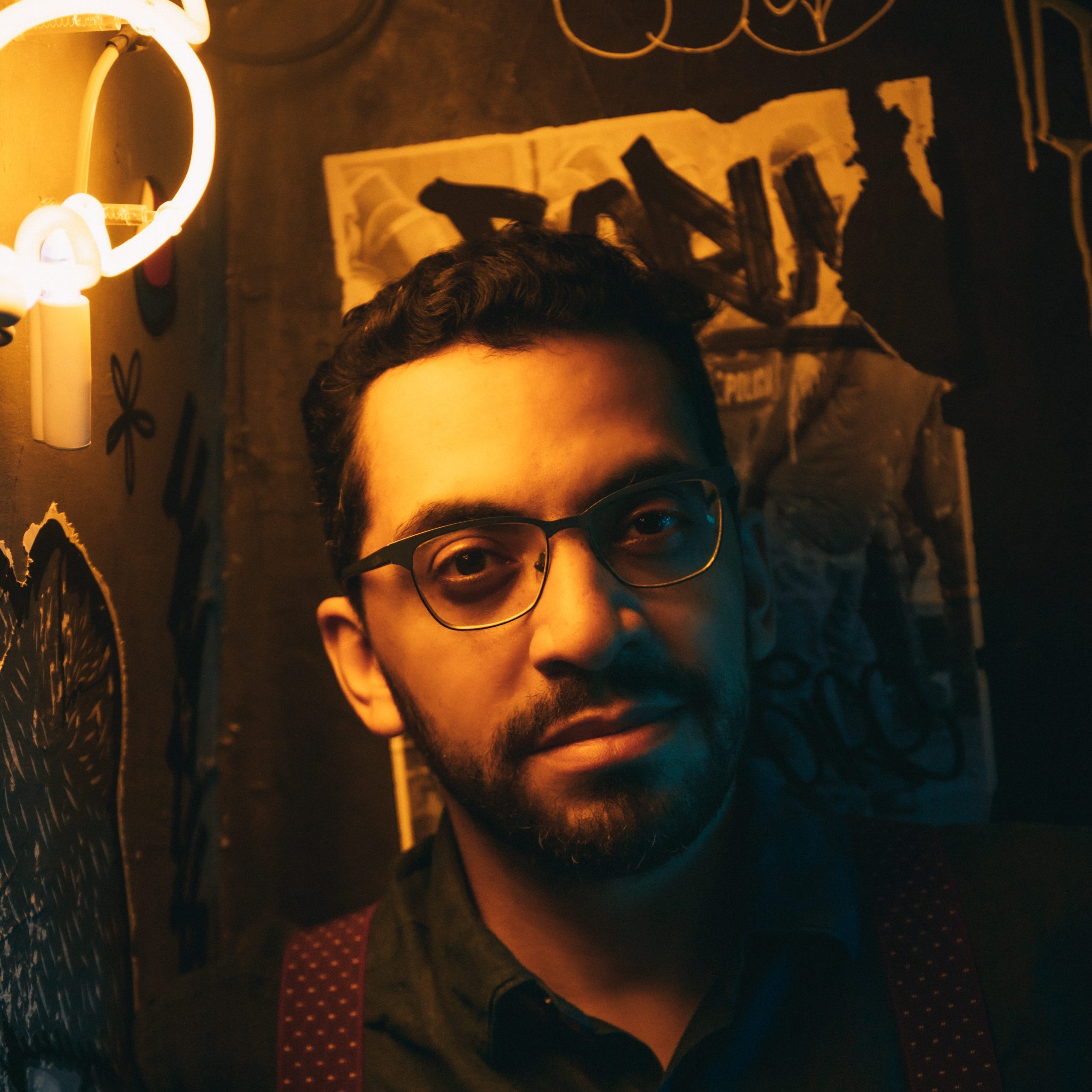
Mustafa Marwan is an Egyptian aid worker with over a decade of experience in more than a dozen conflict zones around the world, including most Arab Spring countries at the highs and lows of their revolutions.
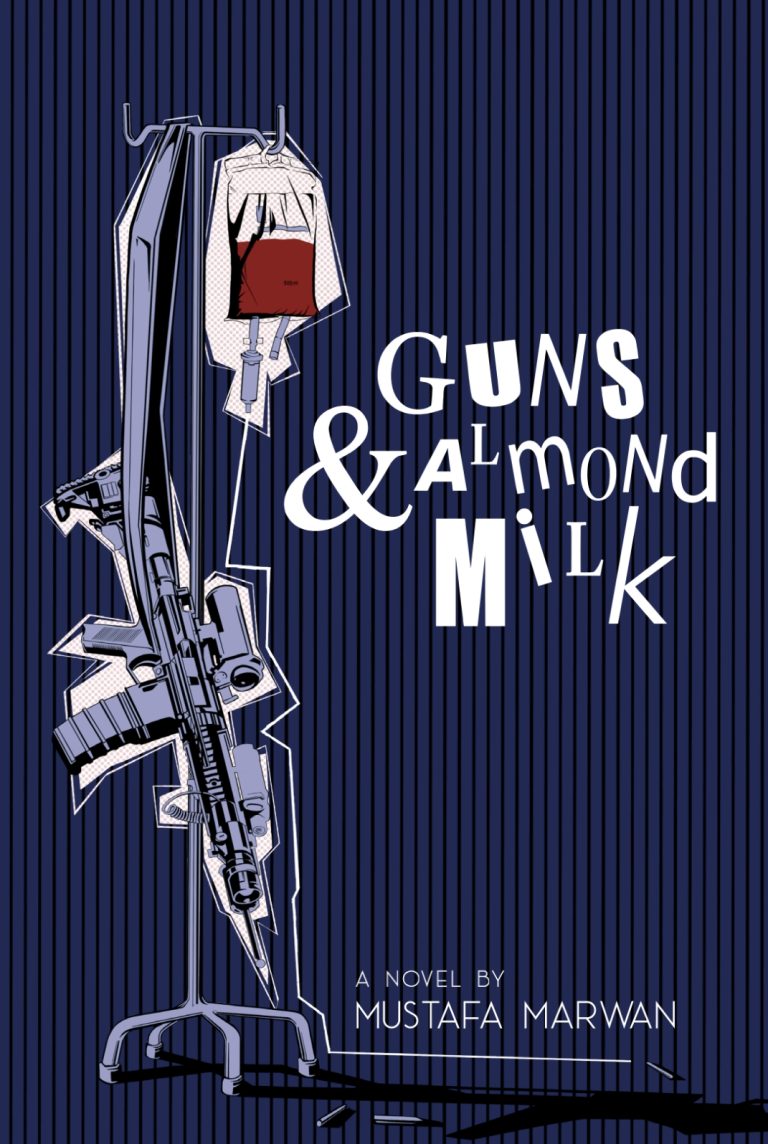
Mustafa has always been a voracious reader. As a child, he devoured any books he could get his hands on, including Russian literature at the age of eleven, and now regularly reads over ten books a month. He has a strong penchant for neo-noir, dark humour and books that strike the magical balance between the literary and the commercial. His debut, Guns & Almond Milk, is a 2021 Page Turner Award finalist.
Academically, Mustafa has a Bachelor’s degree in Pharmacy and two Master’s degrees, one in Public Health, as a Chevening Scholarship recipient in the UK, and another in Nanotechnology.
Mustafa has lectured and consulted in the UK on topics such as Management and Leadership, Health and Social Care. He has also facilitated intercultural dialogue programmes in several countries and was chosen in 2013 as a Youth Leader by the Mosaic Leadership Program, under the auspices of his HRH, Prince of Wales. Mustafa has been working with the International Committee of the Red Cross (ICRC) since 2014 and is currently residing in Geneva, Switzerland.
Facebook: https://www.facebook.com/mustafa.ruan
LinkedIn: https://uk.linkedin.com/in/mustafamarwan

BY NKATEKO MASINGA
This conversation took place between Switzerland and South Africa, via email and a Google document crossing continents.
Nkateko: “One thing they teach you in triage is to pay close attention to the silent ones, because the ones who scream at least have the strength to make noise.” Mustafa, I have to tell you, when I read this line for the first time, I had to step away from your book for a few minutes to catch my breath. There is something strangely fragile about Luke, even at that point where we are still getting to know him, long before any of his personal trauma unfurls. There is an almost mechanical precision to how he tends to patients, but also a masked tenderness that threatens to betray his pursuit of occupational apathy. When did you know for sure that this story would be told in the voice of this particular character, and were you at all surprised by the complexity of his inner landscape, particularly the push and pull between being quiet and finding the strength to scream?
Mustafa: Good question. Luke’s inner voice was one of the earliest things I settled on, even before knowing the ending of the story. Luke is an outsider who doesn’t lack empathy or articulation. By the way, this quote has been told to me in a first aid course I attended. Many events in this novel are based on true encounters. I think it’s a fun exercise to try to guess which is which, especially that some of the true events could be considered far fetched.
Nkateko: Oh, I absolutely believe that this novel is based on true encounters. I came across many scenarios that were familiar to me, or more accurately the version of me that slowly became desensitized by years in the medical field. I remember a friend with much more experience pulling me aside one day to say, “Leave your patients at the hospital. Do not take them home with you”, and it changed how I viewed the field entirely. I became less keen to ‘safely’ debrief with those I felt would understand and began writing as a way to make sense of the public healthcare system in South Africa. I am curious to know how and when your passions for literature and healthcare intersected and what it means to you to exist at the cusp of these two worlds.
Mustafa: In 2011, we were the first international medical team to reach besieged Misrata by sea. Once we arrived, I pulled a pen and paper asking for their needs but the response was, “it’s enough that you came here to witness our story”.
Witnessing the events of most of the Arab Spring countries was a catalyst for me to merge the two fields; Health care and writing.
As for the passion for writing itself, it started a long time ago with one page. A decade later, I came back to that page and finished the novel that became Guns & Almond Milk. I hope this becomes an inspiration for anyone who wants to start writing.
“Aristotle once said that to know a vice from a virtue, you have to know that virtue is never an extreme. It’s always a middle between two vices. For example, courage is a middle between recklessness and cowardice.”
Nkateko: There is another line from the book that stayed with me long after I read it: “Even the righteous sun is hiding behind a foreboding cloud, refusing to bear witness.” There is something powerful about the ability and the intention to both witness and assist. The sun can only witness, therefore appearing uncaring and self-righteous. It takes courage to go out into the field and help, to refuse to hide behind a cloud of distance or lack. In a time such as this, where there are more who need help than those of us who can realistically reach them to physically help, what can we do to not be like the sun, observing but not assisting?
I know that writing is one way of shining a light on injustice and war, but how else do we amplify the stories of those who are injured or silenced? Is it perhaps through foreign aid? I recently completed a course on Effective Altruism and at the end of it, my head was spinning with information about ways in which we can collectively support worthy causes, but there seems to be an agenda about who deserves our assistance here and now, versus finding a way to help everyone who is suffering. Even as a healthcare worker, you can only assist one patient at a time. Do you find this limitation challenging?
Mustafa: That’s a difficult one. I think there’s nothing more sad than a naive humanitarian who thinks they can fix it all. We only do what we can. My motto is goals are means and means are goals, which in short means you need to care about the process more than the unattainable goal. But it’s easier said than done.
Burnout and dropping out are very common among aid workers for exactly the same reasons you are mentioning. I might be pessimistic but I think the current model of foreign-aid is not functional any more. We need to promote more local aid organisations rather than foreign ones.
For the observing and not assisting question, we all have a role to play. It’s just that this role is very different from one person to another. The bottom line is that nobody is required to do more than they actually can.
Nkateko: I wholeheartedly agree with you. That last statement, about only doing what you can, makes me think of Luke’s interpersonal relationships and I wonder if that sentiment is applicable in the context of his connections with Tina and much later, with Rachel. He juxtaposes his memories of Tina against his developing feelings for Rachel, at one point comparing one woman’s sensory effect on him to dopamine and the other’s to serotonin, and I wonder if that is a way of attempting to protect himself from “doing too much” and subsequently getting hurt in the process. It’s as if he dived in head-first with Tina and that with Rachel he is holding back out of fear. I think that in as much as love requires bravery, it also prompts us to exercise caution. It is interesting to explore this vulnerable side of Luke, especially since it is cultivated through adversity. In many ways I could relate to the reflection on a past love whose betrayal is fresh in the mind, and the realisation that there is someone with whom I can have a different, safer experience in the present, in spite of lingering fear and reluctance.
Mustafa: Your interpretation to Luke’s love life is from an angle I haven’t considered before to be honest. Interestingly, it sounds very plausible.
For the serotonin and dopamine comparison, I think it’s true that some women resemble one while others resemble the other. I don’t have scientific evidence to substantiate my claim. Only empirical evidence.
Luke has definitely developed many barriers after what happened with Tina. I agree that it must have been hard for him to trust another woman so easily. He is a stranger in a strange world. His experience with Tina has increased his feeling of “otherness” many folds.
Nkateko: On the topic of unique angles or perspectives, I have always been fascinated by the complex relationship between an author’s intent and a reader’s interpretation. There are literary scholars who believe that authorial intent is superior to any external interpretation or critique. Others believe that the author involuntarily relinquishes their superiority when they hand their work over to be read. My thoughts on this are twofold: As a writer, I believe that the desire to uphold authorial intent is born from a fear of being misunderstood or having my work misinterpreted. However, as a reader, I enjoy the juxtaposition of what the author and the speakers or narrators in the work are giving me, compared to what I am receiving through the lens that I use to view the world and consequently, the literature I engage with. What are your thoughts? Both as a writer and a reader of course.
Mustafa: Both as a writer and a reader, I believe in different angles of perspectives. This is more true in writing than many other narrative art forms like theatre or cinema. In writing, there’s a big room for imagination and I’m often learning more about my characters from different points of views shared by readers.
One key angle for me for example which I don’t think is clearly visible in the theme of the whole novel is how Adam/Luke is trying to be in the middle in worlds of extremes. Aristotle once said that to know a vice from a virtue, you have to know that virtue is never an extreme. It’s always a middle between two vices. For example, courage is a middle between recklessness and cowardice. And so on. Luke is trying throughout the novel to find that magical middle.


Nkateko: The magical middle. What a profound concept. I think that it is as powerful an image as that of the third personality that Adam/Luke alludes to when he admits to himself that he is possibly neither Adam nor Luke in fullness.
Quite early in the book, our protagonist has what I consider an epiphany regarding his identity:
“My new name was my alter ego—what I thought I was. The old me, Adam, was a clear outsider to the others. And between Adam and Luke, the real me had gotten lost. This rebranding wasn’t enough, not for a world that loves simple answers.”
Prior to reading this, I felt a slight discomfort or even distrust towards Luke because it seemed as if he was wearing a mask. When he acknowledges that he rebranded his identity to try to fit in, I realised that his mask was not one of deception but rather of protection, in the same way that he wears a surgical mask to protect himself. I was more sympathetic from that point onwards.
Do you think that it is possible to fully be oneself, or are we constantly putting up a performance for others based on our idea of a palatable, socially acceptable self? I also acknowledge the irony in that performance of self because we cannot control what people think of us.
Mustafa: I think we can’t be fully ourselves simply because we don’t know who we really are. It’s a lifelong quest I guess.
Rachel is the most advanced character in my opinion in terms of being comfortable in her own skin. Yet, she hid the fact that she is Jewish, for example. On a relevant note, I think one of the reasons why Adam was attracted to Rachel is because of her authenticity.
Nkateko: I agree. I have a lot of admiration for Rachel. She is a true humanitarian, making a clear delineation between the war and her work but also making peace with the intersection of the two. During the confrontation with Max, she expresses that she is not part of the war, and yet there remains an undertone of surrender in her demeanor, in that she knows that she will be making means to do her job under continuously challenging circumstances as the overarching goal is to help the injured.
Do you think that Rachel’s quiet and peaceful upbringing has played a role in how she navigates this high-pressure and rather dangerous environment in which she now lives and works? I always picture her retreating to that quiet village in Switzerland in her mind, in order to deal with such a chaotic landscape. It is as if she carries tranquility with her, and it comes across in her ability to emotionally stabilise those around her.
Mustafa: It’s possible. But it’s also possible that she might be running away from her quiet upbringing, just like everybody else. I’ve to admit that Rachel’s character is the hardest to crack for me.
Nkateko: I can relate to that. What I have found is that everything I run away from tends to catch up with me, especially if I have not addressed it or healed from it. Your response regarding Rachel reminds me that the characters in your book can sometimes be as mysterious to you as the author as they are to us as readers. I feel fortunate to have had this opportunity to briefly delve into the world of Guns & Almond Milk with you. It’s a powerful debut. Thank you very much for having this conversation with me. I wish you the very best with your work and your writing, and I look forward to reading more from you in the future.
Mustafa: Thank you so much for your thoughtful questions and for accepting to read a debut by an unknown author who contacted you out of the blue. I’m really happy you liked it and I hope your readers like it too. I forgot to mention, the electronic version of the book is due to be released within a few weeks!
Nkateko: You are most welcome, Mustafa. Our readers will surely love your book, and we look forward to the release of the electronic version too; very exciting news!
Nkateko Masinga is an award-winning South African writer whose poetry has been translated into French, Bengali, Tamil, Kannada and Romanian. Her latest book, Daughter Wound, was published by UK publisher Hazel Press in April 2024 and was named Book of the Week at the London Review Bookshop in the first week of its release.