
The Storyteller is Moved by Empathy: A Dialogue with Michael Chièdoziém Chúkwúderà

THE STORYTELLER IS MOVED BY EMPATHY
A DIALOGUE WITH MICHAEL CHIÈDOZIÉM CHÚKWÚDERÀ
Michael Chièdoziém Chúkwúderà is an Igbo writer whose works have appeared in Jalada Africa, The Republic, Havik, Open Country, Afrocritik, Brittle Paper, Afapinen, Witsprouts, and elsewhere.
His cultural essays and works on literary criticism are widely read in Nigerian literary circles. He is the creative director of the Eagle Nest Bookclub and the Umuofia Arts and Books Festival.
Follow him @ChukwuderaEdozi and write to him at chukwuderamichael@gmail.com.

BY UGOCHUKWU ANADỊ
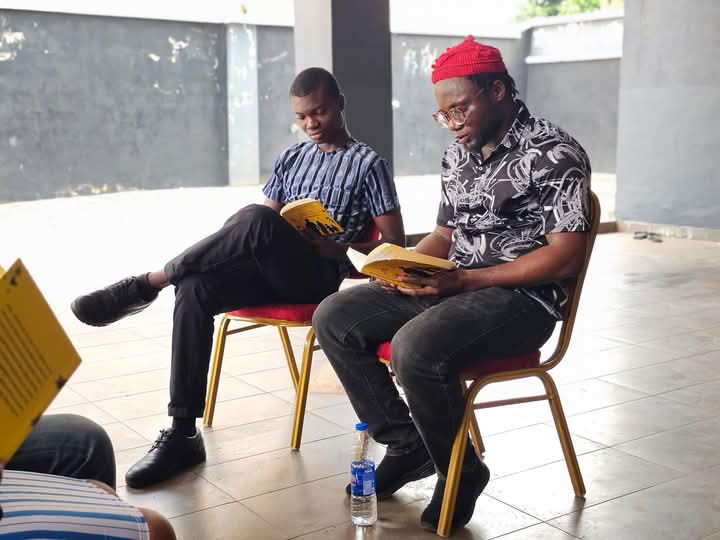
This conversation began in Awka, Nigeria, where the Eagle Nest Bookclub meets for readings, and continued online via WhatsApp.
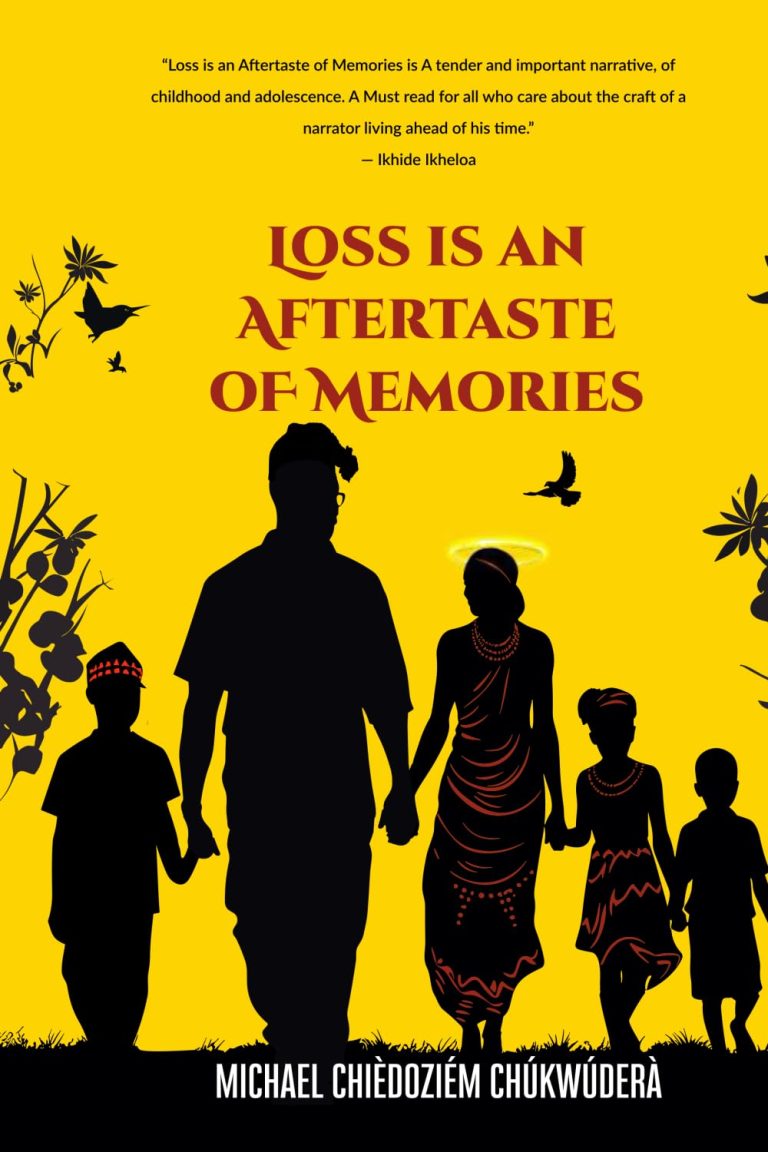
Ugochukwu: Congratulations, Michael, on becoming a novelist. Your debut, Loss is an Aftertaste of Memories, is everything one looks for in a Bildungsroman. How does it feel being a published novelist?
Michael: Thank you, Ugochukwu. It’s such a fantastic feeling to be a novelist, even more so to have people say all these wonderful things to you when they read your work. You feel satisfied that in some way, you have made people feel less lonely through your book, that you have brought people together, which is what the artist hopes to do.
Ugochukwu: The artist hopes to bring people together. That is indeed a great job you have given the artist, a worthy one. I like to think that the critic also hopes to do this, to bring readers together in establishing and discussing the merits and demerits of an artistic creation, in analysing and interpreting creativity. Before now, you’ve made your name in literary, social and cultural criticism. With the publication of your chapbook and novel, you have straddled both roles of being a critic and a creative writer. Is there any difference in the way you hope to bring people together as a critic and in the way you do it as a novelist? I think what I am asking is the ways in which your writing process for these different, even if related fields, diverge and converge.
Michael: As a storyteller you are employing your imagination and observation in bringing characters to life, either fictitiously or not, to share your mindset or your perspective. And you hope that someone out there—or a lot of people perhaps—reads it and feels the same way, or disagrees meaningfully, and your story becomes part of a greater understanding of the human condition. The storyteller is moved by empathy. As a critic, you are driven by an overbearing urge to understand the art beyond the mere surface. You bring your imagination and experiences too but this time as an ardent observer.
It is true that you can also bring people together with your work, but that is not your primary duty. The people could already be together, and you’re perhaps, trying to understand why a particular story succeeds in bringing people together as opposed to another, and to look at them in aggregation and perhaps, have a deeper understanding of how not just the literature, but also the society, functions in their response to art. The critic’s duty is an artistic duty, but it is also to inspect the society’s behaviour, because he is primarily unsatisfied with a surface level of understanding. He is curious. And in his curiosity, he is moved to search for a greater understanding. The critic wants to drive society a step forward in his understanding.
Ugochukwu: “He is curious. And in his curiosity, he is moved to search for a greater understanding.” I love this image of the critic as one driven by curiosity and the urge to understand as against the prevalent image of the critic as that soulless uncle always out to judge and to condemn. And I think that image of the critic being the prevalent one says something about our society and our love for echo chambers. We want to be loved wholly and for many that means not having any of our parts interrogated.
In your novel you seem to care less about the environment than you do about the people found in that environment. In any environment you place your characters, the reader is presented with minimal information about where it is that the character is, with no other details, except for when you compared the cathedral to Nọsike’s home parish (Describing the cathedral they worshipped in on one Christmas, Nọsike observed, “It was not as bright as St. Theresa’s. The stained glasses were on the upper windows of the cathedral and so much light did not penetrate, leaving everything, including the altar, in a shadowy view, as though it was a place where God dwelt in a more secret mode than he did in our parish” (104).
The critic, Chimezie Chika, picked this up in his review where he pointed out that at the end of the novel, Nọsike’s parents’ shop—which played a central role in his upbringing, determining which secondary school he attends to bringing him to the market where he becomes a fighter—remains unknown to the reader. We do not have even the slightest knowledge of what is it that they sell there. Is this a conscious choice you made, or were you just captivated by your characters’ lives so much that you couldn’t pay much attention to rendering their inanimate environment in equal details?
Michael: I certainly did not consciously make the decision to leave out certain details of the settings of the novel, especially as readers will notice that a sense of place is very important to the novel. When I read Chika’s review, I went back to the whole book and was surprised that indeed there’s nowhere in it where it said what Nosike’s parents sold. In the course of editing the novel, about 40,000 words were cut from it, words that were not necessarily bad, but could be taken out without distorting the narrative. I guess that was where the accident happened, because there were whole chapters dedicated to the day-to-day activities in Nosike’s parents’ shop. But then I think that the subconscious processes of rigorous editing after writing has its curiosities. I’ve seen novels in which even the main characters are anonymous in some ways. However, I do want my novels to have a strong sense of place.
“As a storyteller you are employing your imagination and observation in bringing characters to life, either fictitiously or not, to share your mindset or your perspective. And you hope that someone out there—or a lot of people perhaps—reads it and feels the same way, or disagrees meaningfully, and your story becomes part of a greater understanding of the human condition. The storyteller is moved by empathy.“
Ugochukwu: I like how you played around with the dream of kicking sacrificial items kept on the road, the fact that at some points Nọsike cannot even say for certain whether it was his imagination or he had actually done it. That provides some sort of complication and thus an escape route for the author. For the reader, the question arises, did he or did he not kick the sacrificial items? If he did, does it have anything to do with the pains Nọsike would later feel? If it was all a dream, then was it just a premonition, some sort of revelation for what is to come and if it is so, why must the revelation come with Igbo traditionalist symbols to an Igbo Christian family?
It reminds me of how Achebe complicates things in Things Fall Apart, especially regarding the question of whether Okonkwo’s misfortune has anything to do with his slaying of Ikemefuna—whether the gods permit or punish him for that murder—and it helps escape the certainty with which the confusing sickness, Wonjo, that affected the two communities in Elechi Amadi’s The Great Ponds was later discovered to be as a result of the 1918 influenza and not punishment from the gods as widely believed in the community. If Wonjo does not come from Ogbunabalị, the question then arises, how sure are we that every other death attributed to Ogbunabalị comes from the god?
This of course raises an issue with Mama Nnamdi’s orthopaedic practice, and I am bringing it up because you are someone very interested in Igbo cultural revival, a sort of “returning to the roots.” While Mama Nnamdi’s popularity owes to her success with previous orthopaedic cases brought to her, Nọsike’s case is an exception. When the x-ray report comes out, it clearly shows Nọsike doesn’t have a broken leg, which means that his “foot was in perfect order” even when it pains him. This prompts Nọsike’s mother to ask “So it wasn’t a broken bone and that woman went ahead and tied a wood to my son’s leg which almost pained him to death” (21), a disappointment equally shared by Nọsike’s father.
I am establishing this background for it seems to highlight one of the biggest issues we have today when we talk of traditional or alternative medicines and ways of knowing. That lack of clarity, the resort to unnecessary mystifications and the failure to accept lack of adequate knowledge which leads to tying the narratives around some supernatural beings. How do you see this problem being overcome in your push for cultural revival?
Michael: I think that we should keep an open mind in society, especially when seeking solutions to problems whose immediate solutions elude us. One of the things which deter us from learning as we ought to, is that we jump too quickly into conclusions or we limit what we know to our immediate beliefs and judge every mystery according to it, and by so doing, we shut the door to the portal of discoveries which mysteries could lead us to, so to say. In Elechi Amadi’s The Great Ponds people begin to die mysteriously and in great numbers. And it is immediately attributed to Ogbunabali, which is an element of societal myth.
For Nosike, growing up in Benin, a place where belief in the metaphysical is as alive as belief in the physical at a time when traditional belief was still very much alive, we see him begin to contemplate having kicked some food sacrificed to some deity on the road as perhaps the cause of his problems that have eluded all immediate solutions, even though he knows it is very much likely a dream. We are all subject to the beliefs and superstitions of the society we are brought up in, especially at such a young and vulnerable age.
But the redeeming factor, I think, is that Nosike’s father refuses to succumb to that superstition. And in between the speculation and dismissal, a portal was open for continuous search for a solution. The need for keeping an open mind and continuous search makes itself evident here. While I am an advocate for our indigenous spiritualities and cultures, I am also an advocate for a progressive philosophy to accompany it, hence it is not incapable of being put under the light of intense criticism. I try to do that in my work.
We certainly do not need to preserve superstitions that can be unraveled by a bit of scientific inquiry. Returning to our roots is not seeking to return to past beliefs and superstitions, but a way of looking inwards and rediscovering ourselves. A way of seeing ourselves as we truly are, from an authentic point of view and not from an inherited perspective. And even that requires keeping an open mind because that is the only thing which helps us diverge from the inherited or colonial perspective which many of us, as you know, were brought up in.
Ugochukwu: It’s funny how we begin to yearn for the past, with all its imperfections, when faced with the challenges of the present. It is understandable though. Disillusioned by the present, the cheap human reaction is to romanticise the past, to impose the perfections we wish for this present upon it, and to wish to return to that past, forgetting that the past—each era—has its own challenges and it takes the hard work of the people who exist in any era, to solve the era’s problem.
I love that you brought up the issue of being open-minded, of not jumping to conclusions. The need to be in a continuous search for solutions. And that makes me think of our schools and educational institutions, places this sort of attitude should be at the apex.
Being a coming-of-age narrative, many of the scenes in the novel take place in schools and therefore there is no way we can read the novel without engaging our educational practises. I think of that scene at the beginning where the pupils are revising for their final primary school exam… “And if the person said, ‘Money is what we use to buy something,’ we answered them, ‘No, define it like an educated man. The way it is inside the textbook,’… (7).” While the latter answer is a more detailed answer, I find it inadequate that it is not the essentials in that answer that the students pay attention to, that what makes it better is the fact that it is “the way it is inside the textbook,” what we basically refer to as “la cram, la pour.”
Which is to say that rather than the textbook exciting the pupils into wanting to learn more about a subject, its contents are presented to the pupils in a way that closes their minds. This comes at a very formative age for these pupils, meaning that it definitely affects the level of thinking they can engage in as adults. What do you think of this system of education which clearly does not fit into your position that we must continuously search for a solution?

Michael: Michel Foucault famously said that schools serve the same roles as prisons and mental institutions. And this role is to classify, regulate and control people. For the most part, the syllabus we are given in school, and how often our teachers make us follow them religiously … that kind of education is the reason why often in society a lot of people can’t think for themselves. It’s baffling sometimes because it often comes across as though people are often refusing to think, when in truth they have been conditioned not to. I certainly think that saying, “Money is what we use to buy something” for an eight-year-old growing up in Benin is a very good definition because as simplistic as it may look, and even if not with the brightest grammar, it demonstrates that the child is thinking. So what a good teacher could do to improve the child is tell them they are correct and also show them the standard definition in the textbook.
Children are often very intelligent in a pristine way and easily impressionable. When the child sees the textbook definition while being encouraged to also define it their way, they have a way of juxtaposing both definitions in their mind’s eyes and asking themselves what the definition in the textbook has that theirs do not. And then the child is thinking and growing. I think this is what we need more teachers to do. Some of my teachers did it for me in primary and even senior secondary where we were encouraged to study and not cram. It is this kind of education that enables us think for ourselves and introduce us to ideas which expand our mind. A society made up of thinkers is a society of innovators. And innovators are problem solvers. I think too that writers who come from this kind of society will also exhibit social consciousness that is of great benefit in their art.
Ugochukwu: Thinking of that scene more, it is instructive and quite alarming that it wasn’t the teacher discouraging the student from offering thier own definitions but fellow pupils. That so much aligns with your Michel Foucault’s quote, the fact that these pupils have been so worked upon by their teachers they now go on to ensure that the pupils who may still have some sort of originality remaining in them also lose theirs.
You pointed out that some of your teachers did better for you. You had teachers who encouraged you to study and not to cram. And that reminds me of another of Nọsike’s teachers, this time in secondary school. Speaking of how this teacher made him learn how to read pieces written in Edo Language Nọsike observes “And looking back now at how my fear that she might continually ask me to read in subsequent classes materialised, and how each time, I successfully read them, and even took to learning how to read more at home, I have come to realise how love and attention is more of a powerful tool to a teacher than criticism” (161). I take it that here you try to recreate some of those teachers who allowed you to think for yourself while properly guiding you. Are there some exceptional encounters you had with your teachers growing up?
Michael: There are quite a number of exceptional encounters. And it is dizzying to begin to differentiate them. I was fondly loved by most of my teachers. And that made all the difference. I remember that Mrs. Ikpinoko, my headmistress in primary school, gave me and all my siblings fifty percent funded scholarship so we could remain in the school when my parents almost withdrew us after the school fees was increased. She taught me for two terms and in retrospect I think she paid a great deal of attention to me. She would often ask me by the time I was in secondary school, when we met, how I was doing in mathematics. “You used to struggle with Maths,” she would say. And I wasn’t even aware that I struggled with mathematics in primary school. I guess she meant I wasn’t as stellar as I was in other subjects. But my point is with her, as with other teachers I remember fondly, Joy Ozigbo, Ahmed Sule, Philip Eyarefe, Festus Osajere, my parents, and so on, one thing was common among them—interest and attention. That made the student feel that the teachers believe in them and is interested in them and it makes you more confident and makes you want to do more.
Ugochukwu: Catholicism has a constant presence in your novel. I like the length you go to beautifully depict Catholicism in Loss. I think specifically of the description of the monstrance as a “golden cross,” and the comment that the joy that comes with the Holy Communion lies in receiving and not in the tasting. You see, I grew up Catholic and that gives me a lot to smile about, some old memories to revisit. I am curious though, why would a Catholic family be watching Passion of Christ on Christmas and not Good Friday or even Easter. More puzzling is the fact that Nọsike’s parents as Catholic as they are did not baptise them as infants. Is there a backstory we are missing there or was it just a technique you employed so as to have Nọsike be able to actually recollect what receiving the sacraments were like?
Michael: Catholicism was a major component in my formation as a person and in the construction of my imaginative worldview, and I think that makes itself evident in the work. The details about the movie the family was watching during Christmas, and the baptism of the children as teenagers, were mostly because it was how the story came to me. As a writer you don’t always know what you would write or how you would tell the story at certain points. And then you arrive at it and you tell it the way it is before you. It wasn’t just about me, it was also about the people around me. I have friends who were baptised as teenagers, some even as adults. I did not see them as less Catholic growing up. I wasn’t thinking that the Catholicism of Nosike’s parents would come under scrutiny because the children are baptised as teenagers, even though I see how it comes under that light now. But one has to tell the story how the story wants to be told.
Ugochukwu: What’s your current relationship to Catholicism?
Michael: The Irish singer, Enya, describes my relationship with Catholicism very aptly when she says of herself that she had let the religion go. It was the same for me. At some point, due to my personal journey in the cultural, intellectual and creative aspects of my life, I had to let it go. I do have very fond memories of myself as a Catholic and in some ways consider myself one, especially psychologically and a bit culturally. But I had to let the religious aspect go.
Ugochukwu: The growth process can be funny. Okigbo aptly captures it as “a going and coming that goes on forever.” Some come into faith in adulthood, some grow out of it in the same period while some carry it from infancy to grave. I wish you fulfilment in your personal journey.
Your children characters did fall in love, if that is the right word, but they were all platonic. Nobody does as much as steal a kiss or engage in any of such hide-and-seek games we played at childhood, games we know children still play. Are you intentionally creating an idea of children’s innocence or maybe using the novel to suggest that only such a pristine type of love exists between children? It reads like you were intentionally avoiding something? A line from the novel reads, “There are indeed so many things lost in the innocence of childhood for lack of understanding” (49). It seems you are intentionally positioning this innocence against the “corrupt suspicion” of adults…“The sadness which this story aroused in me still echoes each time I remember the story; of how the pure love between two children was brought to an abrupt end by adults, out of corrupt suspicion..” (152). And I understand how frustrating this “corrupt suspicion” can be but let’s focus here on your depiction of childhood innocence.
Michael: The kind of love which I knew as a child was mostly the innocent and platonic kind. Not to say that my experiences were totally pristine. But it was that part of my experience which seemed to fit into Nosike’s story. This is not necessarily the Victorianesque novel where coy intentions are conspicuously missing. I think it is a story which indeed shows that innocence—the beautiful, pristine kind, which upon reflection evokes introspection on a topic like love—is possible in childhood. And for us adults, it becomes like a compass, or a sort of guide for how we consider when we see children exhibiting what might seem like behaviours in adult which are usually tinged with our coyness. So that we are able to look at children with a more open mind and not interfere in their very rich development because of unfounded suspicions.
Ugochukwu: In Loss you described a game Nọsike and his primary school classmates played thus: “During break time, when I was in late kindergarten, and in my early primary school years, the grass of the school field was one of the earliest places my classmates and I chased butterflies and grasshoppers. When we caught them, we caged them in Coconut or Speedy biscuit wraps and, in excitement, watched as they jumped up and down inside the wraps.” Growing up, I played a similar game in primary school. Basically we hunt for grasshoppers and another flying insects we called Benji. Benji is a colourful insect, small and easy to catch. I remember I only engage in hunting for Benji because it looked more colourful, more beautiful and doesn’t need a lot to keep it from not flying away. While others need cans to keep the grasshopper caged so that it doesn’t fly away, you only need to pluck out Benji’s two wings and you can have it crawling on your desk without drawing the teacher’s attention like grasshoppers sometimes do. I think that was why I chose hunting Benji over grasshoppers (It just occurred to me that I don’t know the actual name of the insect and I am not checking. Benji remains Benji to me).
Loss excels in its engagement of children’s psychology. What is it about children and wanting to catch and cage these animals? I suspect that it may have to do with our human predisposition to control, to be in charge, to possess. So we see these animals freer than we can be, and to assert control, we try to capture them and rid them of their flight ability while turning them to mere playthings till we are tired of them and toss them off, not in anyway bothered about how we might have made life more difficult for these animals.
The picture looks very sinister and I wouldn’t want to accept that childhood innocence can also have that in its possession. What do you think caused us at infancy to want to cage these insects?
Michael: I am really shaken by this observation of yours. Especially because with the little I know of Freudian and Jungian psychology, I can really see the validity of your inference. It was a thing that we as children did very innocently at the time. It just gave you joy seeing the grasshoppers hop helplessly in the biscuit nylons. And if you think back at it, there was a lot of caging that was part of childhood. Don’t go here, don’t go there; stay here and wait for me. Sometimes our parents even locked us inside the house. And school itself was a kind of cage, making children sit for hours in a classroom even though many of us would rather be playing in the field. I think that it is possible in some ways that the way we treated the grasshoppers, first going out of our ways to get them and caging them, has some relationships with the way we were caged. Considering that just the way we were often allowed our few minutes of freedom too, that we often let go of the grasshoppers sometimes after we were done, it is possible that the whole scenario could have been a way of replicating what the society did to us as children. But I’m not a psychiatrist or psychotherapist. It does pique the curiosity what inference they would come up with from this.
Ugochukwu: I look back at my own days in secondary school and I can vividly see how school can itself be a kind of cage. I went to a Catholic-owned secondary school, located somewhere at Okpuno, Awka in Anambra State. It was a boarding house and when we came, external free day had been abolished. Some students had abused it, we heard. So, what it meant was that many of us never saw beyond the four walls of the school till the term, usually three months long, is over (save for the one week mid-term break). We had almost zero interaction with the world outside of Tansi College. Even on Sundays when some villagers do attend Mass in our Chapel, our seating arrangement made it impossible to have interactions with these villagers.
The most some of the boys could do was strain their necks, especially on those exceptional Sundays when a fine young girl comes, to observe, and later to discuss the girl. Like the grasshoppers when caged in those biscuit nylons or water cans, we hopped around to leave the school. We manufactured illnesses, resurrected and killed some long dead grandparents, to have our exit card signed so that we could go home. More often than not, these lies are busted, especially if you don’t have an outside collaborator. And when that happens, we become grasshoppers caged in biscuit wraps and placed over an open fire. Tansi College formators know how to punish erring students. Ahhh, you will see shege.
Some later became smart about it. You see, the school has the contacts of all our parents and when we come with claims about dead grandparents and aunts and all that, the procedure was to get this database and call home. But we began to notice that most times they don’t; the person in charge simply doesn’t have the time to start going through the list, since then it wasn’t a digital database (I hope that has changed). So, what they normally did was to ask you to provide your guardian’s number right away. Some students started collaborating with their elder brothers whose number they’ll offer as their father’s and who would corroborate their claims.
Some even took it a step further. They would sneak in phones into the hostel (itself an expulsion offence) and have their friend fake to be the dad. Come see the faking of voices—some are born actors. Whenever such a scheme is going on, we will have to be quiet, those of us in the hostel, and the call put on loudspeaker. Come and see how we hail ourselves on a job well done when at the end of the call, the impersonator was able to convince whichever formator was on the other end of the call.
Thinking about it now, freedom is one thing we have always sought after as human beings. And I see a sense of that pursuit of freedom in the production process of Loss, the first book to be released by Mmụta Publishers, a publishing company you have a hand in. What sort of freedom, in the presentation of narratives, do the Mmụta team seek and how has it been going so far?
Michael: Well, the first was that it got to a stage where I felt the book absolutely had to go into the world. Secondly, the publishing house was created to fill a certain literary lacuna from this region of the country. There is also this nagging feeling I’ve gotten over years of writing and sending works out that excellence in the art is not being given its due especially when one is writing in Africa. Me and my business partner, Gaius Chibueze, had to come together and put the building block to Mmụta Books. As for how far it has gone, it is still in the foundational stages, we plan to publish a few books next year; a collection of poems by Tares Oburumu, the Umuofia Arts and Books Festival Anthology, some Children’s book and a few others we don’t know yet.
Ugochukwu: I think what I like about Mmụta vision as seen in your novel, her first release, that thing I like to refer to as a seeking of freedom, is what you do with language in the book. A kind of freeing the Igbo language and pidgin from all the italicisations and over explaining many editors in publishing houses subject them to. We even see diacritics in use in some of the words, including the author’s name on the cover.
There’s that Achebean ring to your language. That sense of trying to capture in English language the way people who live where your characters live speak in their everyday life.
I think of when a character said “I said to him with sleep still in my voice” (56) instead of saying “still feeling drowsy.” I also think of “I failed to calculate that money but it was enough for me to buy two doughnuts and a big ice cream and still have change” (62) instead of saying “balance” and others like “Obi had gathered mind” (140) instead of Obi became courageous, or something in that line. Was this something you were very conscious of or did you just write the way you hear your characters speak?
Michael: Oh yes, like I’ve said a number of times, Achebe’s “Arrow of God” was the novel which inspired me to become a novelist. And part of what that book did was achieve the apex of how Igbo language could be rendered in the English language. It was so beautiful. The beauty, poetry, and even the outright vulgarity of the Igbo language which we like to avoid was rendered in the book. I read a review once where a person said they did not like the book because it was vulgar and couldn’t stand a dignified man like Ezeulu telling someone to go and eat shit. But this was what made it authentic for me. The Igbo people, poetic as we can be, are very blunt with language. We tell it as it is. And that is one of the characteristics of Igbo novelists (especially those truly steeped in the culture). It affords our narratives lucidity.
At the time when I was beginning to write, there was this fierce debate on the use of language and italicisation led by Ikhide Ikheloa in the literary space. He fiercely kicked against italicisation of local words and over-explaining of certain local lingos. Part of the argument he made were that writers like Tolstoy and Dickens (both of whom I read a lot of as a younger writer) did not explain their terminologies which might be difficult for a little boy growing up in Benin. Yet as serious writers and curious readers, we read these white men who were born centuries ago and make a whole world of sense from their works and the use of language.
Toni Morrison made similar arguments about why she refuses to write about white people. And it might interest you to know that in American literature there was a time that for your narrative to be considered, there had to be white characters in your book, (a way to make sure white people relate with your characters or at least a part of your narrative). But Morrison defied all of that even though she knew in the beginning how difficult it could be for the American literary scene to take her seriously. Things Fall Apart remains the best-selling African novel. It is written in an English that sounds like Igbo. At the end of the day, it is the authenticity that comes from your locality that gives your book its uniqueness. And this authenticity can only be rendered through language. I got to know all of this pretty early in my writing life from reading these wonderful writers and critics. And I employed that knowledge in writing my novels.
Ugochukwu: I can corroborate what you said about the rawness of language as used in the Igbo society, having lived most of my life in Igbo communities myself. Sometimes I listen to the moralists say, when they encounter some vulgar expressions in the music of the younger ones, that this generation has lost it. They create an image of a pristine past, and that is what comes with the romanticisation of the past. I begin to wonder whether these people have actually listened to elderly men and women talk, whether they have actually listened to their songs and jokes.
I am fully initiated into the masquerade cult of my place, Neni. I know some of the things we say, as praise names for the masquerades, and how vulgar they sound. Yet, it’s normal. Come to Night Masquerade events and listen to the masquerades themselves chant. I think the only difference between now and then is that while OdumoduBlvck’s vulgar lyrics can easily be downloaded by any teenager with access to the internet, you needed to be an adult to partake in those events then, thus, proper age screening occurs.
Your title is quite a captivating one, Loss is an Aftertaste of Memories. Nọsike tells his story after having lost someone close to him. Is there a possibility that Nọsike wouldn’t have told his childhood story had this loss not occurred? And what other relationships do loss and memories have?
Michael: It is true that Nosike’s story in Loss is an Aftertaste of Memories has a lot to do with loss, and even enduring losses. But is it possible for the story to remain there if you take away the losses? I think so. The story is not wholly dependent on his losses. It’s not the saddest or most tragic story in the world. It has its moment of laughter and happiness and fun. Nosike was telling his story because he realises like many of us do later in life that our feelings about certain things when they happen change over time. He was trying to show us how dynamic emotions and perspectives are under the light of the revolving knob of memory.
Ugochukwu: Growing up I did something very funny. On a Sunday, I think my dad was sick and my mum stayed home to take care of him. So, I attended Mass alone that morning. After the Eucharistic consecration, they started a fundraising headed by the Catechist. At the mention of ₦10,000, I went out and pledged. I was around seven then and the Catechist said that one can pledge now and redeem the pledge whenever they have the money. The whenever was what caught me, and I imagined myself grown and rich redeeming my pledge of ₦10,000. I went and pledged and was blessed by the priest, who must have assumed I was sent by my parents. Later that evening, a lady visited us. She was my mum’s colleague at work (my mum was a teacher in a school in the community). Now, I didn’t tell my parents about the pledge because I felt it was between me and God. I was going to redeem the pledge when I’m grown and rich. I can remember my parents laughing, they had a good laugh about it, and later paid the money. The teacher that came said she felt something was off when she saw me going home alone and since the fundraising wasn’t pre-announced, she knew my parents couldn’t have asked me to make the pledge.
Nọsike’s attempt to receive the Holy Communion with his age mates at a time he hasn’t been deemed worthy to receive the sacrament reminds me of that event. Of course, mine was less serious, even though it brought an unplanned expense to the family. But I think many of us who grew up in the Church had some of these funny and not-so-funny experiences.
What were yours?
Michael: Your experience is indeed funny and interesting. The church was a fascinating place, and a lot of those activities done there fascinates you especially when you are unable to partake in them at the time, yet the way these activities are being talked about made them seem open-ended, even though they were policed by certain criteria—I am talking about the Eucharist here. You needed to be in a state of grace to receive it, and a state of grace was a state of relative sinlessness. And in my childhood, there were times I really felt I was good and hadn’t done a lot of bad things. And there was this fascination with how the Eucharist tasted. Oh this round white or milky stuff that was the body of Christ which people were not allowed to say anything when it was dropped on their mouth, what was it like? My experience was similar to Nọsike’s. I tried to receive but did not succeed. Looking back now it sometimes seemed I was tongue-tied at that moment when I should have said “Amen” and when I finally got to receive about five or six years later, it was one of the best nights of my life. There were times too when I thought of going for confessions before I had received the Eucharist, but never quite got around to it.
Ugochukwu: I never had that temptation with the Holy Eucharist, maybe because I received it when I was eight years old. I attempted to when I was seven but I failed the Catechism exams. I was pained but my mother made it less painful by reminding me that I didn’t start the Catechism classes on time, that it would have been a miracle had I passed. I tried the following year and aced the exams.
There is a sense in which Nọsike’s surgeries remind me of my sister’s. Like Nọsike, she was operated upon twice. I was still very young then so I didn’t know exactly what the procedure was for. I just knew, as my parents told me, that something was in her throat that should not be there. The second surgery was to correct a mistake the first surgeon made. I remember the silence and fear that invaded the household when it was discovered during the checkup that the first surgeon had made a mistake. The hospital offered to bear the cost of the second operation but my parents refused. They had lost trust in the hospital and sought another. Fortunately for all of us, the corrective surgery went well. And she did well in the speech training that followed the surgery.
It gets me thinking of how things like that just befall children, sometimes multiple times that it begins to look like the child is marked. Doesn’t it look like Nọsike is marked for misfortunes?
Michael: I think misfortune is an integral part of life. It befalls everyone. It’s part of what makes life interesting. Nọsike’s story is definitely more interesting because of some of the misfortunes he faced, especially when placed side-by-side with his fortunes and his pleasant life experiences and also the times when life was just going normally. It makes his story multi-dimensional. Of course, in life there are times when one goes through one misfortune after another, and one is forced to pause and consider if there are forces behind it. Like that Achebe’s saying that when suffering knocks at your door and you tell him you have no seat for him, he tells you not to worry that he has come with his own stool.
It comes to us all at some point. I think sometimes, there probably is something behind one’s suffering outside of oneself, but most times, one suffers so that one can learn endurance and grow. And from this phase of my life, I am learning how pain is one of the surest forms of evidence that one is alive. Those who have gone through extended periods of feeling nothing will tell you it’s better to feel pain and suffer than feel nothing. And those who have gone through extended periods of uneventfulness in their lives will also tell you how their first misfortune in a long time shook them up and helped them grow. I think the real problem is when one is unable to move past the source of their pain or is irredeemably broken by their misfortune.
Ugochukwu: Nọsike is now an adult but his story that we have stops in his teenage years. Are we to expect a sequel?
Michael: Well, I suppose in the far future there could be one, but I’m working on a series of books now that Nọsike’s story is not at the centre of any of them. But sure, nothing is impossible.
Ugochukwu: That’s great. Success on your current projects. It’s been blissful having this conversation with you. Once again, congratulations on your debut novel.
Michael: Thank you.

Ugochukwu Anadị is a Contributor at The African Theatre Magazine and the Book Reviews Editor at Afreecan Read. A graduate of the University of Nigeria, Nsukka, he has been awarded for his book reviews, stories and essays.
He has also gotten a fair share of journal and magazine publications and is currently interested in how the literary conversationist, the person who interviews authors on their works, contributes to the literary world, an interest he aims to pursue in an essay.
He currently interns at Griots Lounge Publishing, Canada and has previously interned at Counterclock and Narrative Landscape Press.


